How to Read US Nutrition Labels
A breakdown of the Nutrition Facts panel on US packaged foods: what each line means, how serving sizes work, and where Japanese labels differ.
Every US packaged food carries a standardized Nutrition Facts panel. If you are used to Japanese labels, the format and logic differ enough to trip you up.
---
Basics
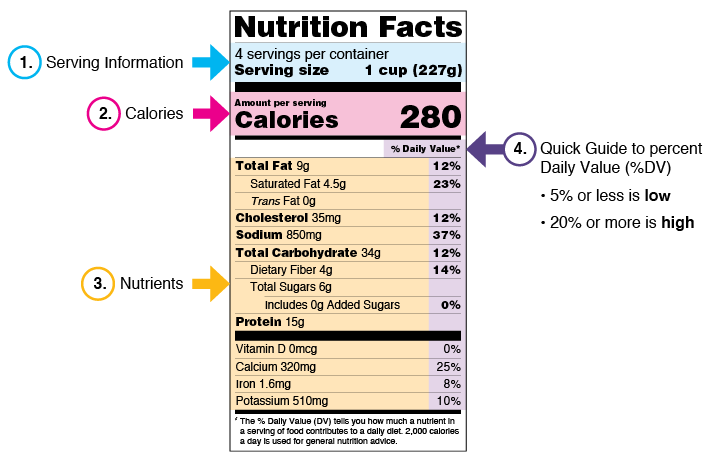
The white-and-black Nutrition Facts panel is required by the FDA on virtually all packaged food sold in the United States. Here is how it is structured, top to bottom.
① **Serving Size** comes first. Everything below it (calories, fat, sodium) is measured *per that serving*, not per package. A bag of chips might list "About 8 servings" with a serving size of 28g. If you eat half the bag, you are eating four times the numbers shown.
② **Calories** is the big bold number. This is kilocalories (the same unit Japan calls kcal), not kilojoules.
③ **Nutrients** are listed in this order:
- **Total Fat** (with Saturated Fat and Trans Fat indented below)
- **Cholesterol**
- **Sodium**
- **Total Carbohydrate** (with Dietary Fiber, Total Sugars, and Added Sugars below)
- **Protein**
Below these you'll find select vitamins and minerals. Vitamin D, Calcium, Iron, and Potassium are mandatory.
④ **% Daily Value (%DV)** appears on the right column. It tells you what percentage of a day's recommended intake one serving provides, based on a 2,000-calorie diet. As a quick rule: 5% DV or less is low, 20% DV or more is high.
**Ingredients list** appears separately, usually below or beside the panel. Ingredients are listed in descending order by weight, the first ingredient is what the product contains most of.
---
Watch Out For
**Serving sizes are standardized reference amounts, not realistic portion sizes.** They often do not match how much people actually eat. A serving size may be "1/2 a granola bar," but most people eat the whole bar. If you ignore serving size, the numbers can make a food look healthier than it is.
**"0 kcal" and "sugar-free" have legal thresholds, not literal meanings.** The FDA allows "0 calories" if a standard serving contains less than 5 calories, and "zero sugar" or "sugar-free" if it contains less than 0.5g of total sugar. A soda maker could define one serving as a single sip (about 4 kcal) and call the product calorie-free, even though the full bottle might contain 400 kcal.
**Japanese labels use per-100g (or per-100ml); US labels use per-serving.** Direct comparison between a US product and a Japanese equivalent requires math unless you normalize both to the same basis.
**Front-of-package claims need context.** "Natural" has no regulated definition for most foods. "Organic" with the USDA seal means at least 95% organic ingredients and is USDA-verified. "Non-GMO Project Verified" is a third-party certification, not a government standard. "Made with organic ingredients" requires only 70%.
**"Added Sugars" is a US-specific line.** Japan does not separate natural sugars (such as lactose in milk) from added sugars. In the US, that distinction appears on the label. The FDA recommends no more than 50g of added sugars per day for adults.
---
Action Steps
1. Before comparing two products, confirm you are using the same serving size, or normalize both to per-100g.
2. Use the %DV column as a quick filter: if sodium exceeds 20% DV per serving, treat it as a high-sodium food.
3. Read the ingredients list. If the first three ingredients are forms of sugar (sucrose, high-fructose corn syrup, dextrose), sugar is likely the main component regardless of what the front of the box says.
4. For organic claims, look for the green-and-white USDA Organic seal, not just the word "organic" in the product name.
5. When buying for young children, pay extra attention to Added Sugars and Sodium. %DV percentages are calibrated for adults on a 2,000-calorie diet.
---
Takeaway
US nutrition labels are useful once you adjust for serving size. The %DV column helps with quick comparison shopping. When you are unsure, read the ingredients list. It usually tells you more about what you are buying than the front of the package.
---
FAQ
Can I compare a US nutrition label with a Japanese one directly?
Not without conversion. US labels show values per serving (a portion size defined by the FDA), while Japanese labels show values per 100g or 100ml. To compare, divide the US numbers by the serving size in grams, then multiply by 100 to get a per-100g figure. Only then are the two labels on the same scale.
Are US "Calories" the same as Japanese kcal?
Yes. The "Calories" number on a US label is identical to kcal in Japan. Both refer to kilocalories. The US simply drops the "kilo" prefix in everyday usage. If a US label says 200 Calories, that is 200 kcal.
Is food labeled "natural" actually regulated in the United States?
No. Unlike "Organic" (which requires USDA certification and at least 95% organic ingredients), the word "natural" has no binding legal definition for most food products in the US. Any manufacturer can print it on packaging. If you want a meaningful quality signal, look for the green-and-white USDA Organic seal instead.
---
*Note: This guide provides general information only. For personalized guidance tailored to your family's needs, please see our [concierge services](/jp#contact) (Japanese-language support available).*